Laurens County Revolutionary War Battlefield Permanently Protected, Added to The Liberty Trail

August 3, 2023

 The Hammond’s Store Battlefield most recent addition to statewide driving tour

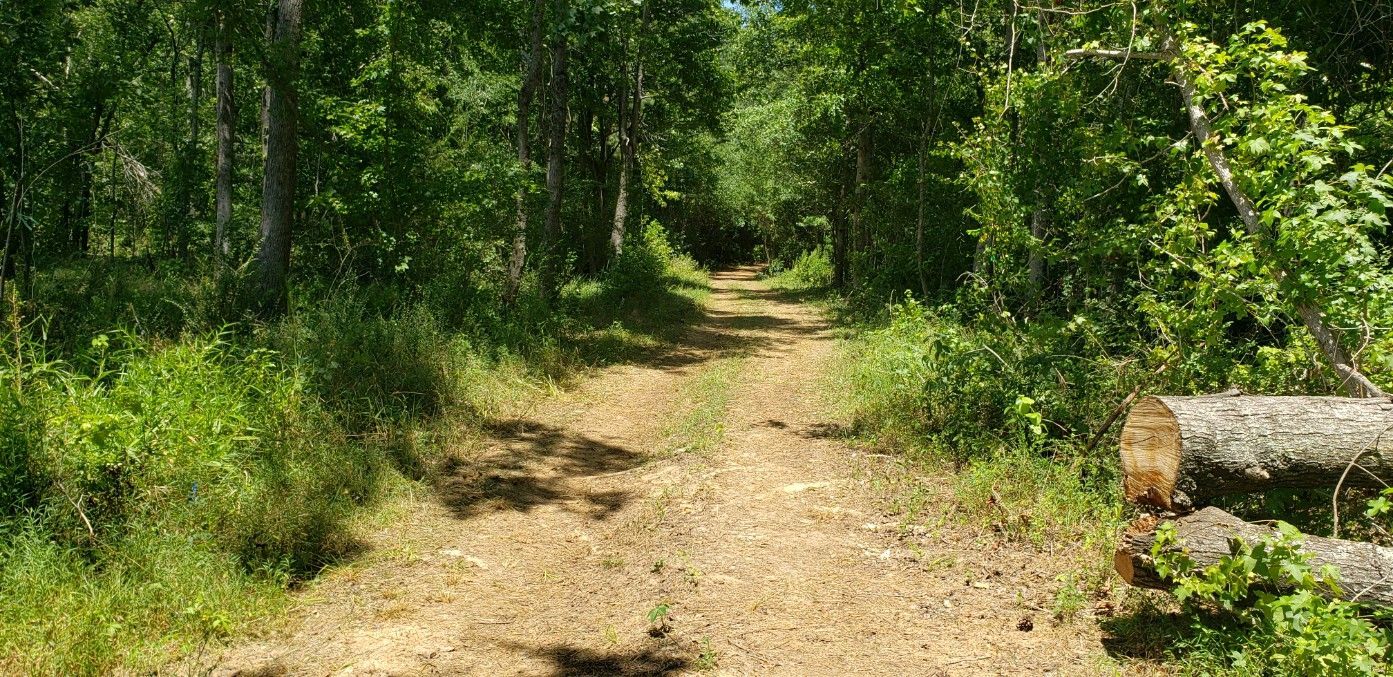
CHARLESTON, S.C. – August 3, 2023 –The South Carolina Battleground Trust today announced the acquisition of the Hammond’s Store Battlefield near Clinton in Laurens County, South Carolina. These 30 acres associated with the December 30, 1780, engagement will be incorporated into The Liberty Trail initiative, augmented with trails and interpretation to tell the story of the Revolutionary War in South Carolina. The Liberty Trail, a partnership of the South Carolina Battleground Trust and the American Battlefield Trust, is a driving trail of Revolutionary War battlefields throughout South Carolina.


“During the time between the well-known battles of Camden and Cowpens, battles and skirmishes waged on in South Carolina’s backcountry pitting neighbor against neighbor as Patriots and Loyalists both sought to gain ground,” commented Doug Bostick, CEO, South Carolina Battleground Preservation Trust. “The Battle of Hammond’s Store was a victory that resulted in no loss of life for the Patriots and laid the foundation was an important precursor to the Battle of Cowpens.”


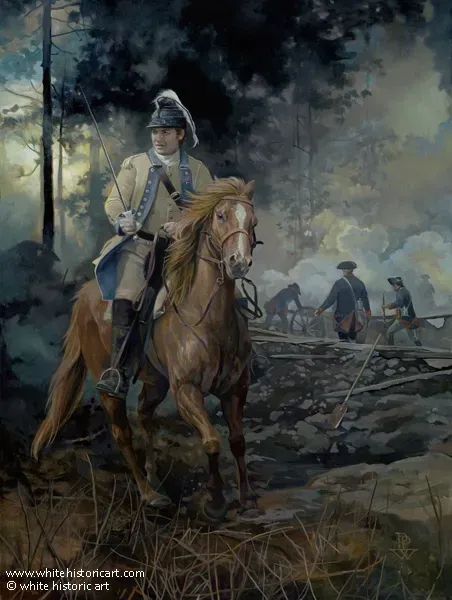
In December 1780, Patriot Brigadier General Daniel Morgan camped on the Pacolet River where he received intelligence that Lieutenant Colonel Thomas Waters had assembled Loyalist troops at Fair Forest. These Loyalists were attacking settlements of Patriot families between the backcountry villages of Winnsborough and Ninety Six. Morgan dispatched Lieutenant Colonel William Washington’s dragoons and mounted militia to harass and antagonize the Loyalists. Waters fell back 40 miles when he learned of Washington's advance. Washington pursued Walters for many miles behind enemy lines until, on December 30, Washington's Continental Light dragoons and 200 South Carolina mounted state troops overtook the 250-person Loyalist militia unit under Waters along the road leading to Hammond’s Store, only 25 miles from the British post at Ninety Six. 


After placing militia riflemen on his flanks, Washington’s cavalry directly charged down, across the stream, the headwaters of the Bush River, and up the slope. Thomas Young, a Patriot with Washington, wrote, “When we came in sight, we perceived that the Tories had formed in a line on the brow of the hill opposite to us. We had a long hill to descend and another to rise. Col. Washington and his dragoons gave a shout, drew swords, and charged down the hill like madmen. The Tories flew in every direction without firing a gun. We took great many prisoners and killed a few.” The Loyalist losses were more than 100 men killed or injured beyond recovery. The Patriots took 40 prisoners and captured 50 horses, without loss. 


The next day, Washington detached the Little River Regiment mounted troops under Colonel Joseph Hayes and a small Continental Light Dragoons detachment under Cornet James Simons to flush out Loyalist Brigadier General Robert Cunningham and Major Patrick Cunningham occupying Williams' fort, a wooden palisaded farmhouse. Cunningham’s men chose to abandon the fort and slipped away deep inside British controlled territory. Washington’s men returned to Morgan's camp and engaged in the Battle of Cowpens on January 17. 


“The Battle of Hammond’s Store expands the narrative of The Liberty Trail by shedding light on the conflicts in the South Carolina backcountry,” commented David Duncan, president, American Battlefield Trust. “We look forward to adding this location to the growing number of publicly accessible, interpreted sites along the trail.”


Two archaeological studies of the battlefield site have been completed and a more intensive study is now underway. “The colonial roadbed has been located,” added Bostick. “Over the coming year, we anticipate completing trails and interpretive signage for battlefield visitors.” 


The acquisition of the Hammond’s Store Battlefield was made possible by a grant from the South Carolina Conservation Bank, the South Carolina American Revolution Sestercentennial Commission, and the Laurens County 250th Commission.  

###


About The Liberty Trail
The Liberty Trail is a joint effort of the South Carolina Battleground Preservation Trust and the American Battlefield Trust, assisted by numerous partners at the local, state, and federal levels. The statewide driving tour functions as a one-of-a-kind educational and heritage tourism resource through which key battlefields of the Southern Campaign of the American Revolution will be preserved, interpreted, and promoted. For more information on The Liberty Trail initiative, including historic background and a list of those sites that are part of the Initial Phase of the project, visit www.thelibertytrail.org. As The Liberty Trail takes shape, partners, friends, and history enthusiasts are invited to follow its progress on social media using the hashtag #TheLibertyTrail.


Media Contact

Jennifer Howard

jen@stewardterra.com

843.709.4192


November 11, 2026
On this Veterans Day , we want to recognize all who have served our Nation. All Veterans, every branch of service, all who supported the defense of our great country, even when it was only a concept of a land independent of Great Britain. So let us focus on one of those American Revolutionary War battles and remember the Veterans who were there. The sound was overpowering. Musket volleys and the blast of artillery roared across the battlefield. The cacophony included the beating of drums, shouted orders, huzzas, and screams from both sides as they engaged with musket, bayonet, and sword. The cries of the wounded and dying. All echoing through the pines that early August morning in the fight along the sandy ridge. Thirst was prevalent for every soldier. But there was no time to drink. Every breath brought in the smell of sulfur and blood. Gunsmoke hung thick in the humid early morning air. Visibility was merely yards through the towering, longleaf pines. And in this setting, the Continentals of the 1st Maryland Brigade, on the east side of the battlefield, were slowly being pushed back to the Great Wagon Road. Lt. Gen. Charles, Earl Cornwallis then exploited the gap between the Maryland brigades. Soldiers of the 7th Regiment of the 1st Maryland Brigade were now practically surrounded, trying to hold as long as they could. Their sergeant formed them back-to-back, defending each other against the British attack. But they began to fall. By gunshot and bayonet, they succumbed. And at the end of the battle, five of them were thrown on top of each other into a hastily dug grave less than a foot and a half deep, and hardly five feet wide. And there they rested along with almost 400 others, American and British, on the hallowed grounds of Camden Battlefield . And one of them we now know was 16-year-old Private John Pumphrey of the Seventh Regiment, buried with four of his fellow soldiers. Veterans of the American Revolutionary War. But the sacrifice they made was not in vain. Their holding out so long allowed others to get away. They gave their lives not for themselves, but for others: those who escaped went on to fight at Cowpens, Guilford Courthouse, Hobkirk Hill, Ninety Six, and Eutaw Springs until the British evacuated Charleston in December 1782. They were Veterans, living and dead, who helped create the great nation that our current Veterans serve today. On Veterans Day, we remember them all, and thank them all for their service. They have served at Cowpens, Fort McHenry, Tripoli, Mexico City, Antietam, San Juan Hill, Meuse-Argonne, Normandy, Iwo Jima, Khe Sanh, Grenada, First Gulf War, Fallujah, Kandahar, and strikes against Iran: in our nation’s wars for over 250 years. Different uniforms, different weapons, different places worldwide, different armed services, but all Veterans serving the United States of America. The South Carolina Battleground Preservation Trust asks you to thank a Veteran today. Thank them for their service, for their commitment to a calling higher than themselves, and for their defense in peace and war. Please generously donate to help us preserve, protect, interpret, and educate our citizens about the battlegrounds and military sites in South Carolina, as we continue to honor our Veterans by preserving the hallowed grounds where they fought. 
June 29, 2026
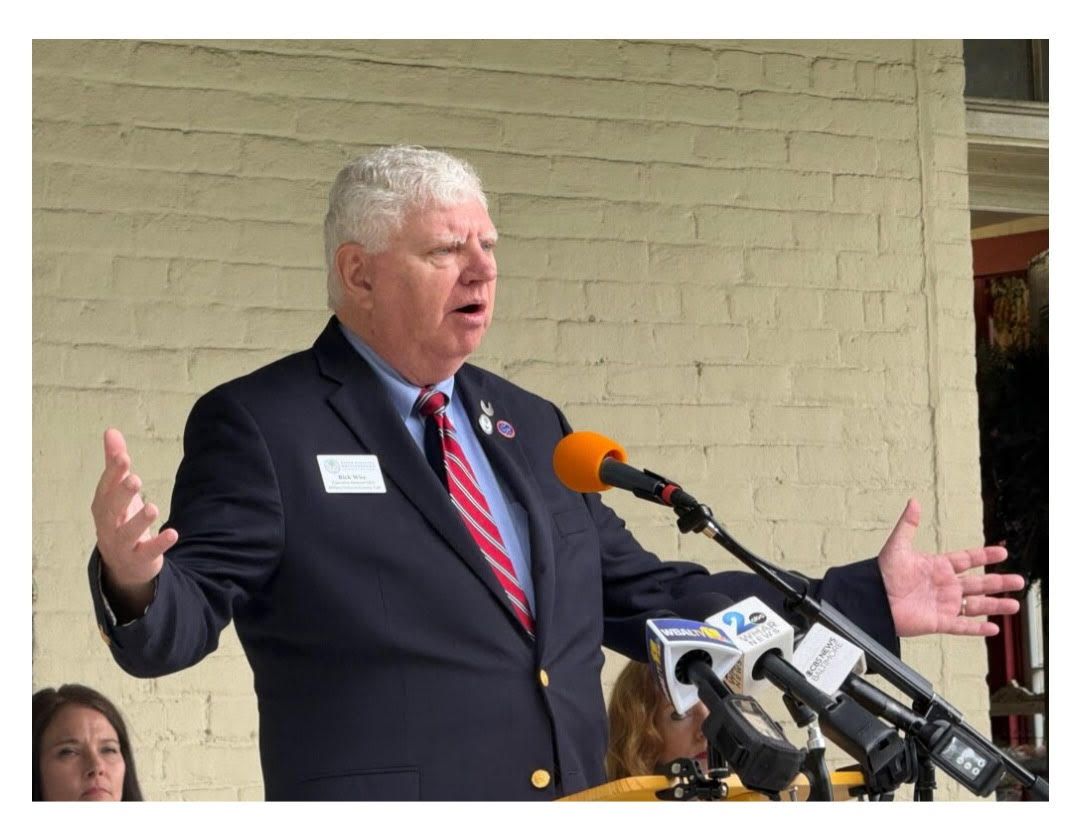
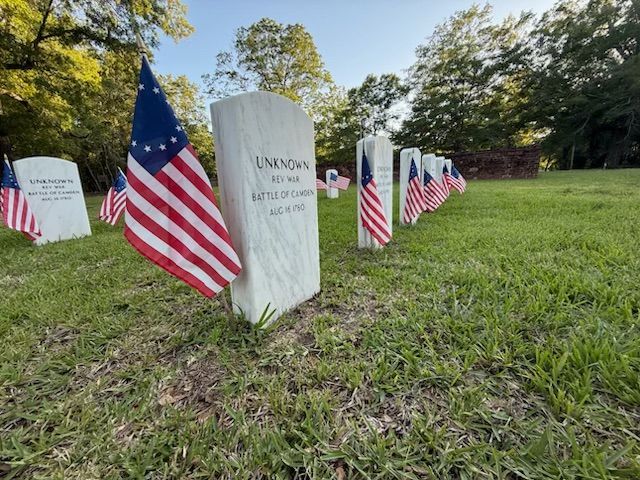
Archaeologists Dr. Steve Smith and Jim Legg worked to find artifacts to tell the story at the Camden Battlefield for over 20 years. They knew the grave was there. The final one to complete the project. Hits from metal detectors again revealed they were in the right place. The grave site was slowly excavated, and hours ran into days. As the grave opening was expanded, the revelation was solemn. Not one, not two, but a total of five soldiers in a grave only about 14 inches deep and no more than four feet wide. They were known as Camden 9A through 9E. Continental USA buttons and other artifacts proved which side they were on. Forensic Anthropologists, Dr. Madeline Atwell and Dr. Bill Stevens meticulously worked to recover the remains, which were removed to the Richland County Coroner’s office. More forensics study was done, and the potential for DNA evidence was contemplated. The late Doug Bostick, Executive Director/CEO of the South Carolina Battleground Preservation Trust, started this amazing journey. His concept to protect and preserve soldiers from graves that were threatened by erosion and other hazards led to the project in the Fall of 2022. The initial plan was to excavate six grave sites. Ultimately, eight grave sites were found and excavated, revealing 14 soldiers. Each was unknown. Artifacts showed the army for which they fought. Possible brigade-sized units were surmised from the location of their graves on the battlefield. They were honored in April 2023 at Bethesda Presbyterian Church in Camden, and at the battlefield where about 400 of their comrades in arms still lie in shallow, unmarked graves. The Continentals now lie at rest in the Presbyterian Burial Grounds, managed by the historic Quaker Cemetery in Camden. And beneath the marble headstones marked “Unknown,” they waited. The Historic Camden Foundation, under Cary Briggs and Stacey Ferguson, led the efforts to determine whether the DNA could possibly be used to determine the identity of any of the recovered soldiers. They contracted Allison Peacock of FHD Forensics and her team to work their genetic and genealogy magic. And it worked. An identity was proven, and an anxious family awaited the official word. And when the word did come, the team effort that made this possible coalesced for the next step in the journey: Rick Wise traveled to Maryland to tell the descendants about their ancestor’s steps and sacrifice during the Revolutionary War. In an emotional address to the family, Wise emphasized the gravity of the moment, noting that it was the first time in nearly 246 years that his name, Private John Pumphrey, was spoken out loud for his relatives to hear his name. Tears flowed from relatives as Wise detailed the harrowing experiences of Pumphrey and the Maryland troops, who marched on battlefields and sites that echo with history: Brandywine, Germantown, Valley Forge, Monmouth Courthouse, and Camden. Wise illustrated their courage in how Pumphrey and his comrades held the line against overwhelming odds at Camden . He characterized their actions as selfless sacrifice, intended to secure the freedoms enjoyed not by themselves, but by generations of Americans, including ours today. The successful DNA identification of Private Pumphrey is a crucial breakthrough, allowing historians and the family to trace his specific journey to the Battle of Camden . Private John Pumphrey is representative of all those who remain in shallow, unmarked graves across the hallowed grounds of the Camden Battlefield. As we approach the 250th Anniversary of America and the Declaration of Independence, let us say a prayer for our first Veterans, who lie in hallowed grounds across our original 13 colonies, who gave their all for a new nation not yet realized, the United States of America.
May 25, 2026
Memorial Day calls us to honor those who did not come home to celebratory ceremonies and flags, but gave their lives to a nation that we must work to make worthy of their sacrifice.
SHOW MORE